
The Version Nobody Wants to Recognize
The Shyamalan Film that Closes an 18-Year Trilogy and Opens a Question with No Answer
There’s a version of you that you built to survive. Not to live — to survive. The one that shows up when someone pushes too hard. The one that knows exactly what to say to keep people at the distance you choose. You built it so well that sometimes you can’t tell if it’s you or if it’s her. And when she does something you don’t want to own, you blame her. You give her a name. You turn her into someone else. As if that absolved you of having created her in the first place.
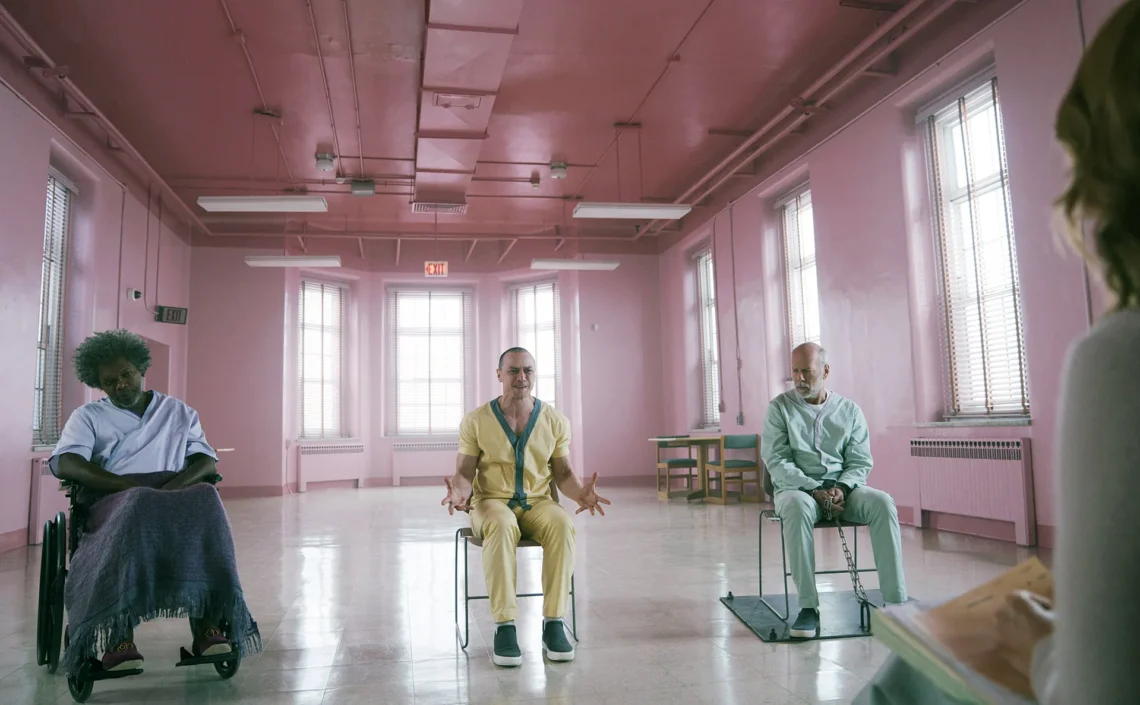
Glass (2019) is the closing chapter of the trilogy M. Night Shyamalan began with Unbreakable (2000) and continued with Split (2017). The three protagonists of those films — David Dunn (Bruce Willis), Elijah Price (Samuel L. Jackson) and Kevin Wendell Crumb (James McAvoy) — converge in a psychiatric hospital where a doctor has one single mission: to convince them their powers don’t exist. That it’s all the product of a mind that prefers fantasy to reality. Now streaming.
Kevin has twenty-four personalities. One of them is named Patricia. Sophisticated, calculated, gentle in her manners and ruthless in her objectives. Nobody chooses her — she appears when the others can’t. Everyone inside Kevin respects her. Or fears her. Patricia doesn’t ask permission or apologize. She simply does what needs to be done and lets the others process the consequences. McAvoy shifts from Patricia to Hedwig — a nine-year-old boy — in under thirty seconds. And the most disturbing thing isn’t the speed. It’s that you recognize them both. That something in you knows exactly what they’re made of.
That’s what Glass has that the other two didn’t in quite the same way. It doesn’t ask whether superheroes exist. It asks whether the versions you built of yourself are really yours or just a response to what the world did to you. Whether David Dunn became invincible because he chose it or because he had no other way to survive. Whether Elijah destroyed because he was a villain or because the world never gave him another role. Whether Kevin is broken or whether he simply found more ways than anyone else to stay whole.
Eighteen years after Unbreakable, Shyamalan closes the trilogy in a parking lot, not a skyscraper. No special effects. No grand salvation. Just three people who built extraordinary versions of themselves to survive ordinary lives. And a question that stays with you long after the credits roll
has it already done its job, or do you still need it?


2 Comments
Pingback:
Pingback: